
Our sales manager will contact you shortly

 Plastic buckets14 sizes · 560 ml to 21 L
 Medical buckets9 sizes · 1 to 21 L
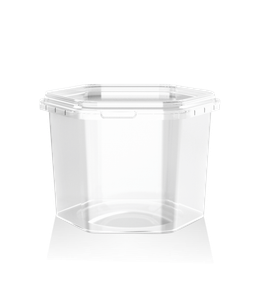 Food containers5 formats · 250 to 750 ml
 Plastic jerry cans5 L and 10 LPlastic buckets16 models, 560 ml - 21 LMedical buckets10 models, 1 - 21 LFood containers5 models, 250 - 750 mlPlastic canisters5 and 10 L塑料桶16 个型号,560 毫升 - 21 升食品容器5 个型号,250 - 750 毫升塑料方桶5 升和 10 升
Hello! We'll suggest the right size for your product, calculate pallets, and quote a price for your order.
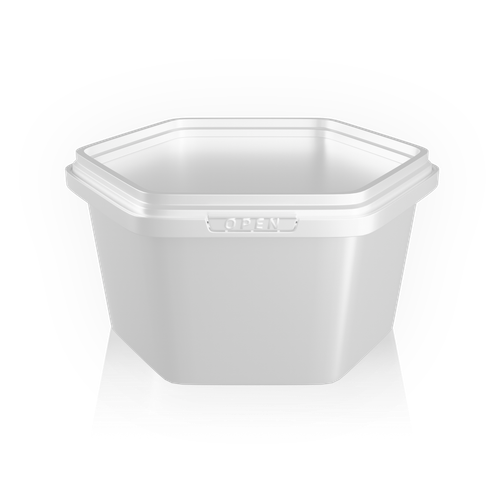
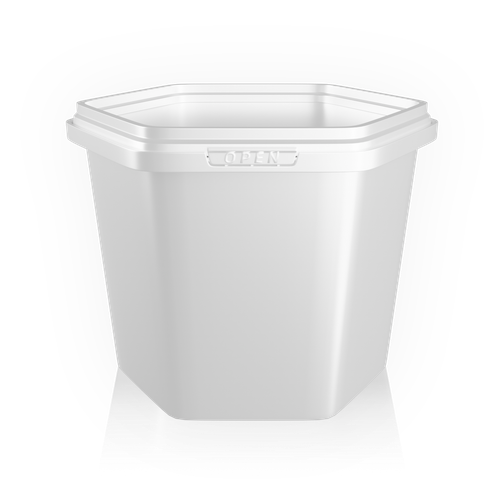
Put these two food containers side by side and look from above. You can't tell them apart: the top is 110 x 100.5 mm, the base is 90 x 80 mm, and both ship 17,600 units per pallet. The only difference is body height: 50 mm for the smaller one, 77 mm for the larger. Below, we put the numbers for both in one table, explain the differences that matter in daily use, and show which size fits which job. We mold both containers in the Bishkek Free Economic Zone and ship them across Kyrgyzstan and to Kazakhstan.
The data comes from our catalog pages. Where a row shows the same figure twice, the two containers share that trait; where the figures differ, you see what changes when you move up a size. Sour cream weight assumes a density of about 1.0 kg/L, filled to nominal capacity. Liters per pallet shows how much product one pallet of empty containers will hold.
| Parameter | 250 ml container | 400 ml container |
|---|---|---|
| Model | PHD250 | PHD400 |
| Nominal / brim-full | 250 / 300 ml | 400 / 450 ml |
| Top dimensions | 110 x 100.5 mm | 110 x 100.5 mm |
| Bottom dimensions | 90 x 80 mm | 90 x 80 mm |
| Height without lid | 50 mm | 77 mm |
| Empty weight | 13 g | 16.5 g |
| Units / liters of product per pallet | 17,600 / 4,400 | 17,600 / 7,040 |
| Sour cream, filled to nominal | about 250 g | about 400 g |
Logistically, the two are identical: the same pallet, the same spot on the display shelf. Two things change: how much product ships on that pallet, and how much plastic goes into each liter of product, about 41 g for the larger one and 52 g for the smaller. If your portion works in either size, the 400 ml is more economical.
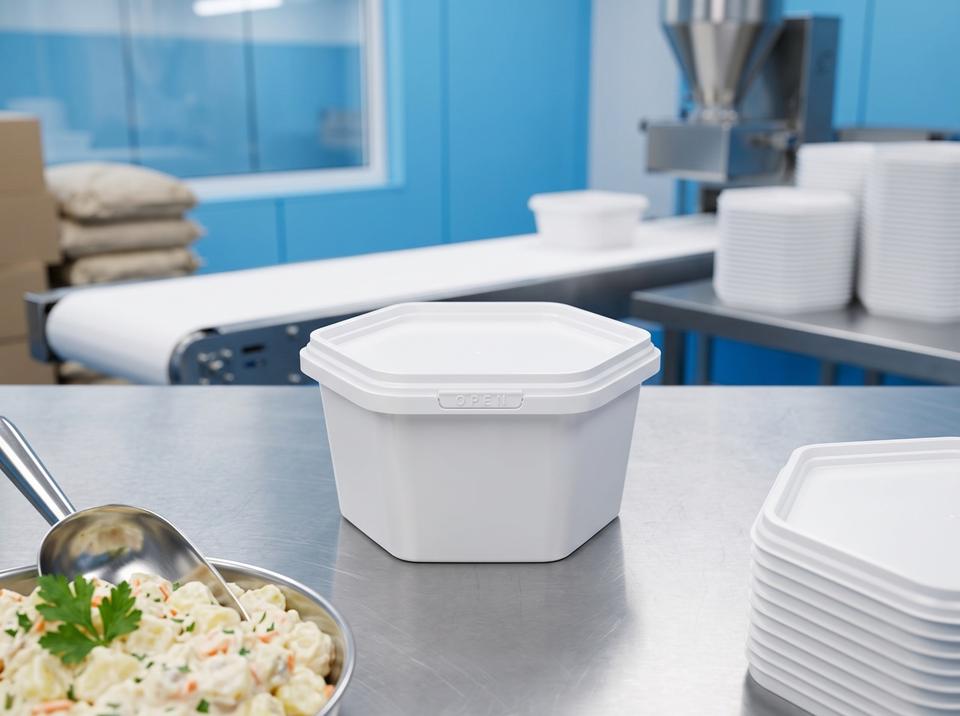
Choose a product and a monthly volume to compare net weight, units per tonne, liters per pallet, and pallets per month for each size. We calculate from nominal capacity and the product's weight per liter, as on our packaging guides.
The top and base are identical, so everything that sets these containers apart comes from body height. The difference shows in four places: at the scale and on the price tag, on the display shelf, in resin calculations, and on the cold-room shelf, where filled containers stack in tiers.
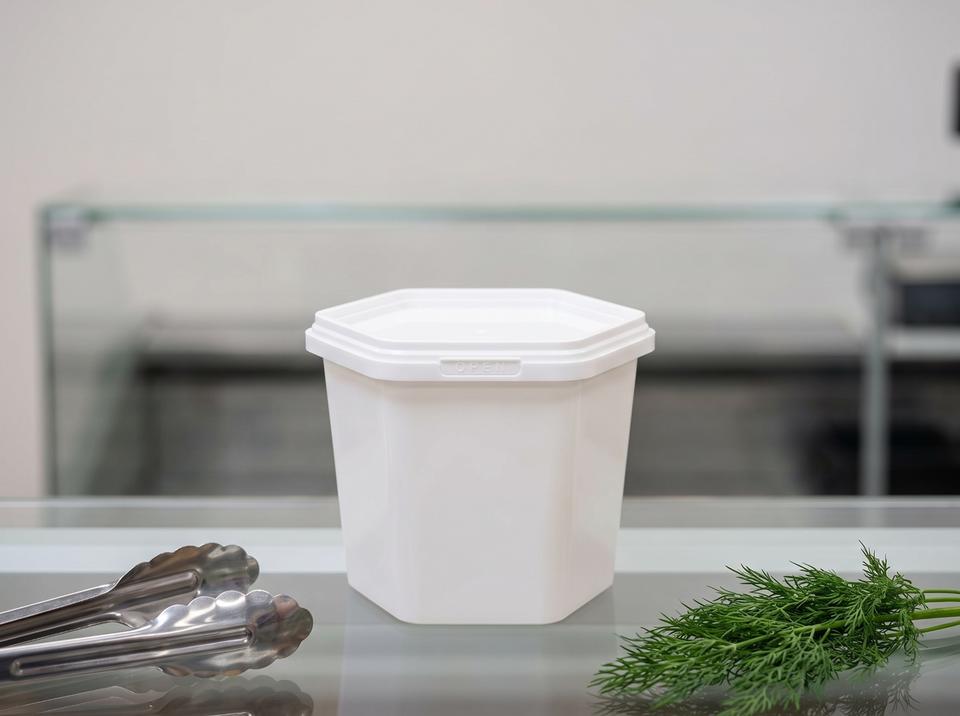
The 250 ml holds a single serving: sauce for manty, sour cream for breakfast, or a dessert with coffee. The 400 ml is a family-size portion or two meals: salad for dinner, or cottage cheese for syrniki (farmer cheese pancakes). The portion also sets the price on the tag, so buyers often choose the size and the price together.
From above, at a shopper's eye level, both containers look the same. The difference shows from the side. The tall, clear wall of the 400 ml shows the layers of a salad or dessert, while the low 250 ml shows off only what's on top.
The larger container weighs only 3.5 g more but holds 150 ml more. That works out to about 41 g of packaging per liter, versus 52 g for the smaller one, and over a year of purchasing, the difference adds up.
Filled containers are stacked on a cold-room shelf or in a courier bag. Each 400 ml tier is 27 mm taller, not counting the lid, so five tiers add up to an extra 135 mm. Check your shelf height before you move a product to the larger size.
The short answer: choose 250 ml when you need a small portion at an affordable price. Choose 400 ml when shoppers buy more and you want less packaging per liter of product.
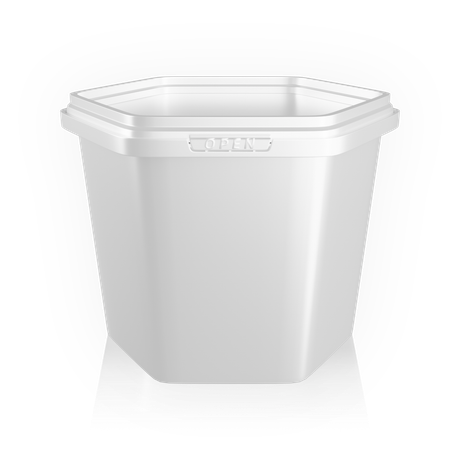
Full product details are on the pages for the 250 ml container and the 400 ml container. For how these sizes perform in sales, see the pages for dessert containers and salad and deli containers.
Both containers ship 17,600 to a pallet, so switching sizes doesn't change the number of pallet spaces in the truck, and a mixed shipment is easy to plan. You can pick up pallets at the factory warehouse in the Bishkek Free Economic Zone, Ak-Chiy village. Our own trucks deliver in Bishkek and the Chuy Region, and a freight carrier serves Osh, Jalal-Abad, Karakol, Naryn, and Talas. Pallets go to Almaty, Astana, Shymkent, Karaganda, and other cities in Kazakhstan within the EAEU. Your sales manager confirms delivery time and cost when you place your order.
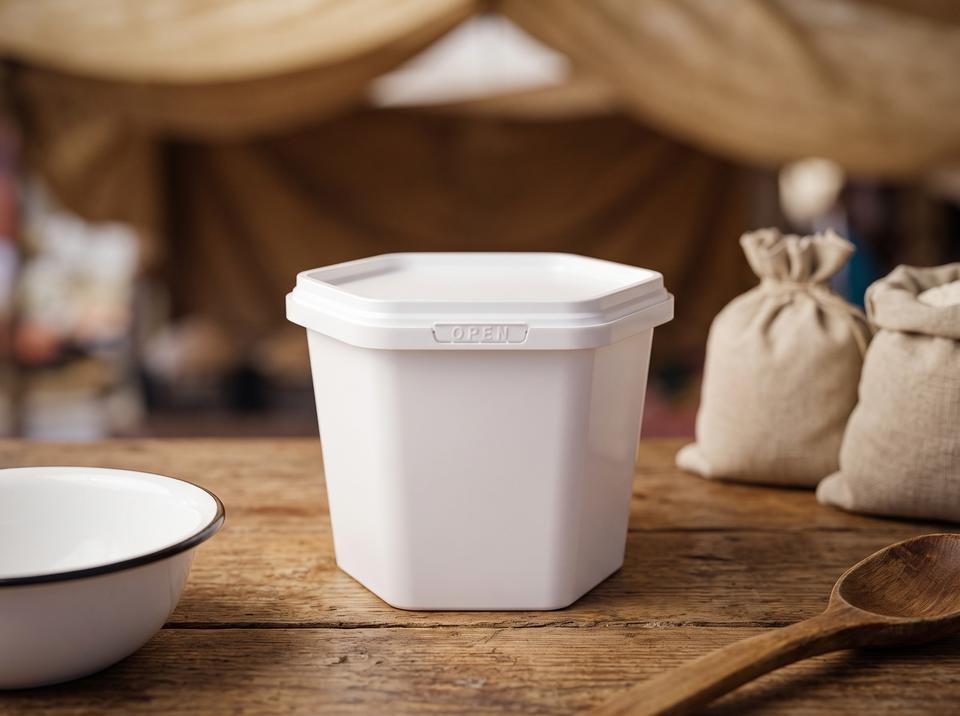
In body height and everything that follows from it: 50 mm vs 77 mm, 300 ml brim-full vs 450 ml, 13 g empty weight vs 16.5 g. The top and base dimensions and the units per pallet are the same.
Both containers have the same 110 x 100.5 mm top. If you want one lid stock for both sizes, ask our sales manager to confirm compatibility when you order. We confirm it for each specific batch.
About 250 and 400 g when filled to nominal capacity, since a liter of sour cream weighs roughly 1 kg. Brim-full, the containers hold 300 and 450 ml, but that extra room lets the lid seat without pushing product out.
The 400 ml. It uses about 41 g of plastic per liter of product vs 52 g for the 250 ml. One pallet carries 7,040 liters of product vs 4,400, with the same number of containers.
Your sales manager prices each order based on size, color, quantity, and decoration. Call +996 222 600 292 and ask for a quote on both sizes so you can compare.
Yes. We can apply a label to the lid or wall, or use in-mold labeling (IML) on the lid, where the label is fused into the lid during molding. The 400 ml has a taller wall, so there is more room for artwork on it.
Yes, by the pallet within the EAEU: to Almaty, Astana, Shymkent, Karaganda, and other cities. Your sales manager confirms delivery time and cost when you place your order.
Tell us your product, portion weight, and where you sell it. Your sales manager will recommend a size, and if you're still unsure, order a trial batch of both containers and see which one sells faster from the display.