Want to learn more about our packaging or find the right fit for your business? Request a callback, and our specialist will call you at a time that suits you. Tell us about your product, and we'll help you choose the best option.
Order a callback from a specialist
Want to learn more about our solutions or find the perfect solution for your business? Leave a request for a callback and our specialist will contact you at a convenient time. Together we will find the optimal solution to make your business thrive!
Request a callback from our HR team
Interested in our openings and career opportunities? Leave your contact details and our HR team will get back to you shortly. We'll answer your questions and explain how to join the HTI Group team.
Order a callback from a specialist
Would you like to learn more about our job openings and career opportunities? Leave your contact information, and our HR department will get in touch with you shortly. We will answer all your questions and provide detailed information on how to become part of the HTI Group team.
Mon-Fri, 9:00 AM-5:00 PM · Factory in the Bishkek Free Economic Zone, Ak-Chiy village
Rice, orchards, and apiaries
Plastic bucketsand packaging in Uzgen
You can buy plastic buckets in Uzgen straight from the manufacturer: the HTI Group plant near Bishkek. Uzgen is an ancient town in Osh Region, known for its old minaret and for the rice the south prizes for plov. The town is ringed by rice paddies, vegetable gardens, orchards, and apiaries, and nearly every family puts something up to sell: pickles, preserves, honey, premium rice. For all of it, HTI Group molds food-grade buckets from 560 ml to 21 L, plus 5 L and 10 L jerry cans, in the Bishkek Free Economic Zone (FEZ) and ships them to Uzgen by freight carrier.
Farms count their harvest in kilograms, but packaging is ordered in liters. Under each of the fourteen buckets, you'll find which Uzgen District product goes in it and how much it holds by weight. Weights are given for pickles in brine, preserves, honey, and water, since their weight per liter is known. Rice and other dry goods are weighed right at packing, so for those we just name a suitable size.
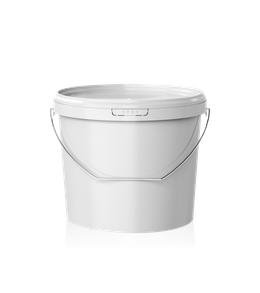
Honey, preserves, and appetizers in single portions for bazaar shoppers.
Home-canned goods for families, teahouses, and the bazaar stall.
Batch pickling, honey for resellers, and rice stocked for winter.
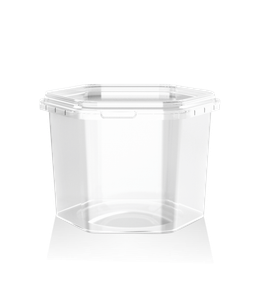
Containers for plov, salads, honey, and preserves in single portions.
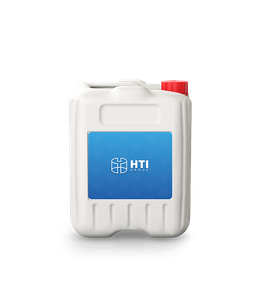
Jerry cans for water in the fields and oil in the kitchen.
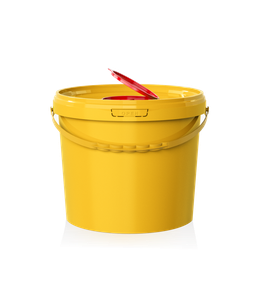
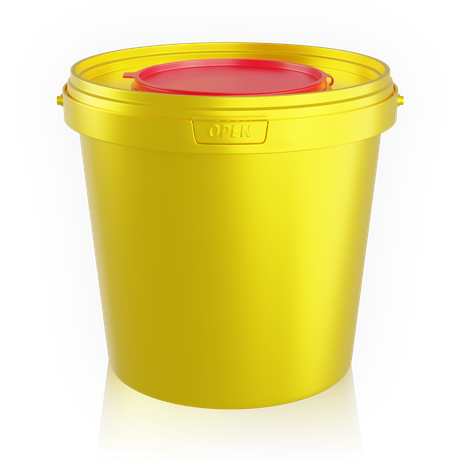
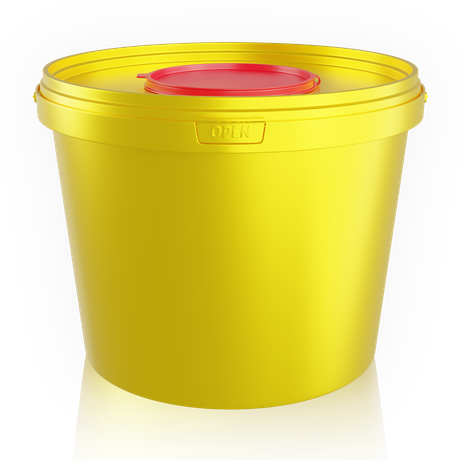
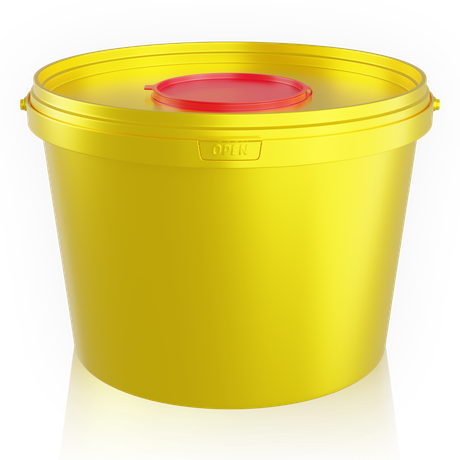
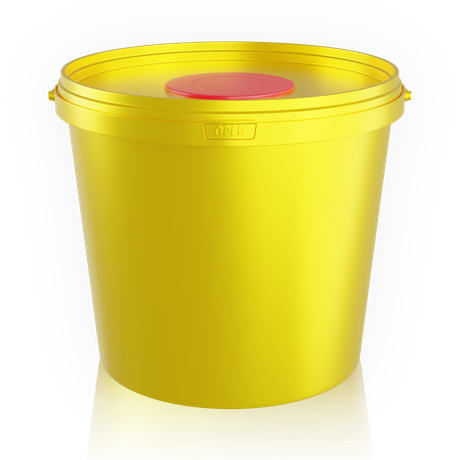
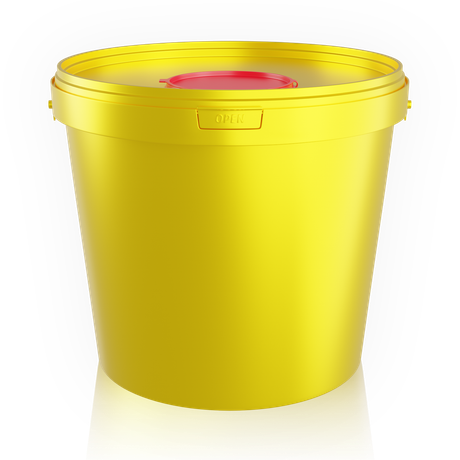
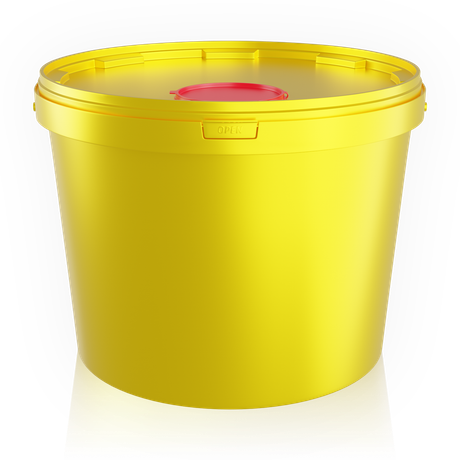
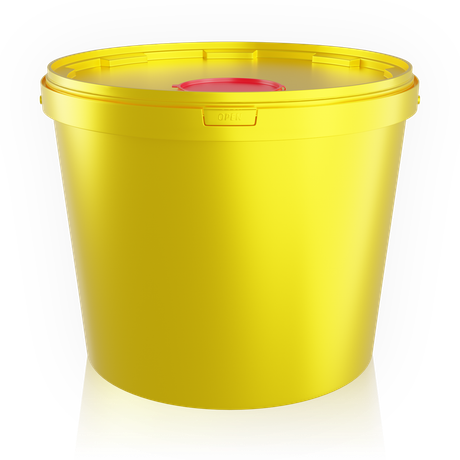
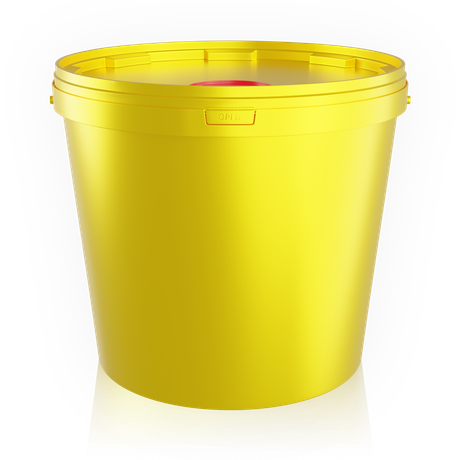
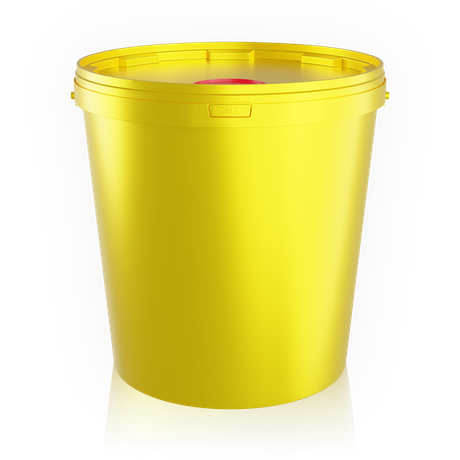
Yellow buckets for Class B waste, red for Class C (by Kyrgyz sanitary classification): for the hospital, rural health posts, and district vets.
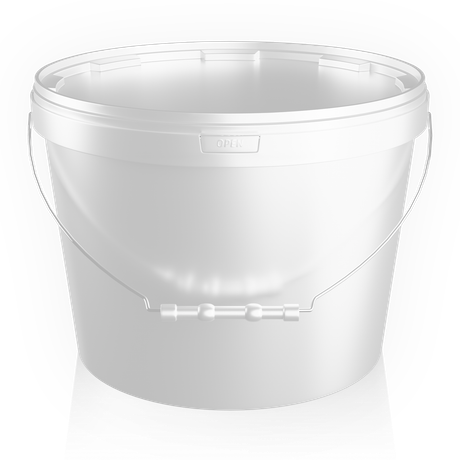
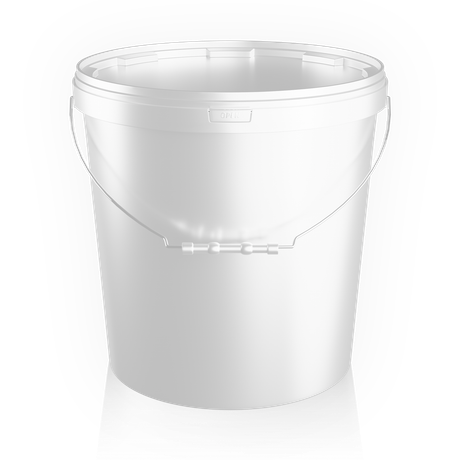
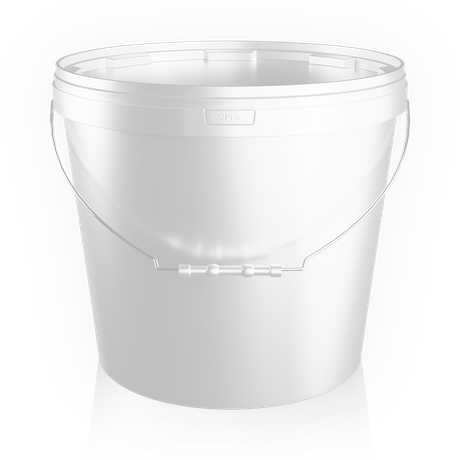
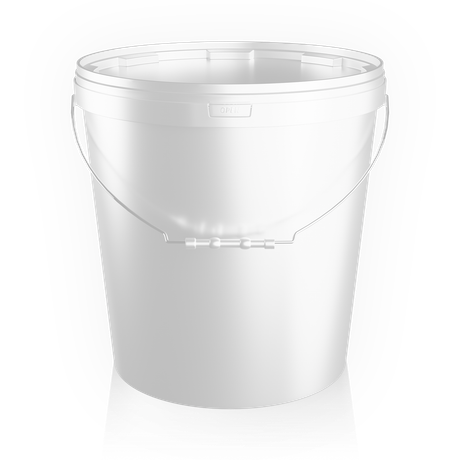
Packaging at the same scale: body width and height from the factory's product cards
Counter · PKS560
560 ml plastic bucket
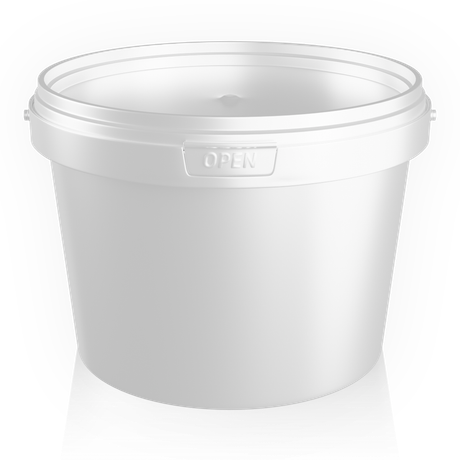
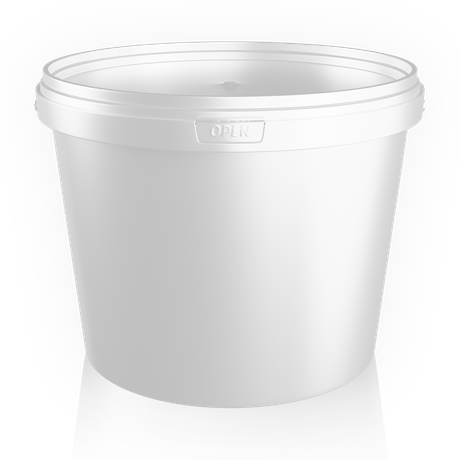
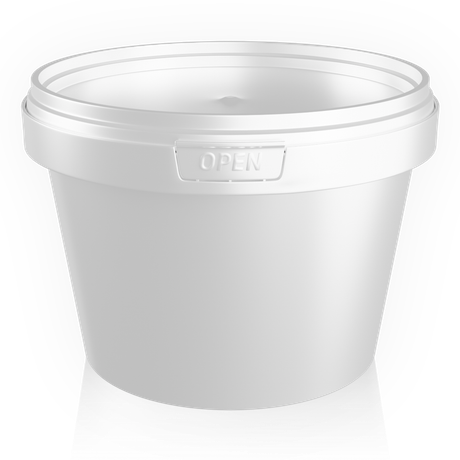
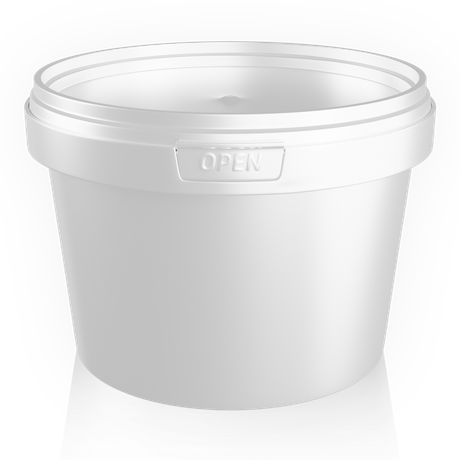
Honey samples and gifts for the road: the small handleless bucket holds about 0.8 kg, with an OPEN tear strip on the lid.
People often pick a bucket that's too big for bazaar pickles, and twelve kilograms of cabbage in brine is heavy to carry and slow to sell. For the stall, 2.3 to 5.6 L works better; save the large sizes for cafes and wholesalers. Rice looks great in a clear bucket: the grain shows through the wall, so there's no need to take the lid off for shoppers.
An Uzgen farm rarely lives off a single product. In summer, vegetables and fruit are picked and beekeepers extract honey; in fall, the rice comes in. Every crop has to be stored somewhere and sold in something, and each has its own packaging needs.
Pickling for cafes11.5 L: about 12.1 kg of cabbage with brine
Rice as a gift
People take Uzgen rice to relatives in Bishkek and other cities and give it as a holiday gift. A 3.8 L bucket with a lid and bail handle beats a sack: the grain won't spill, the bucket won't get crushed in your luggage, and once the rice is gone, it's still useful around the house.
Vegetables for pickling
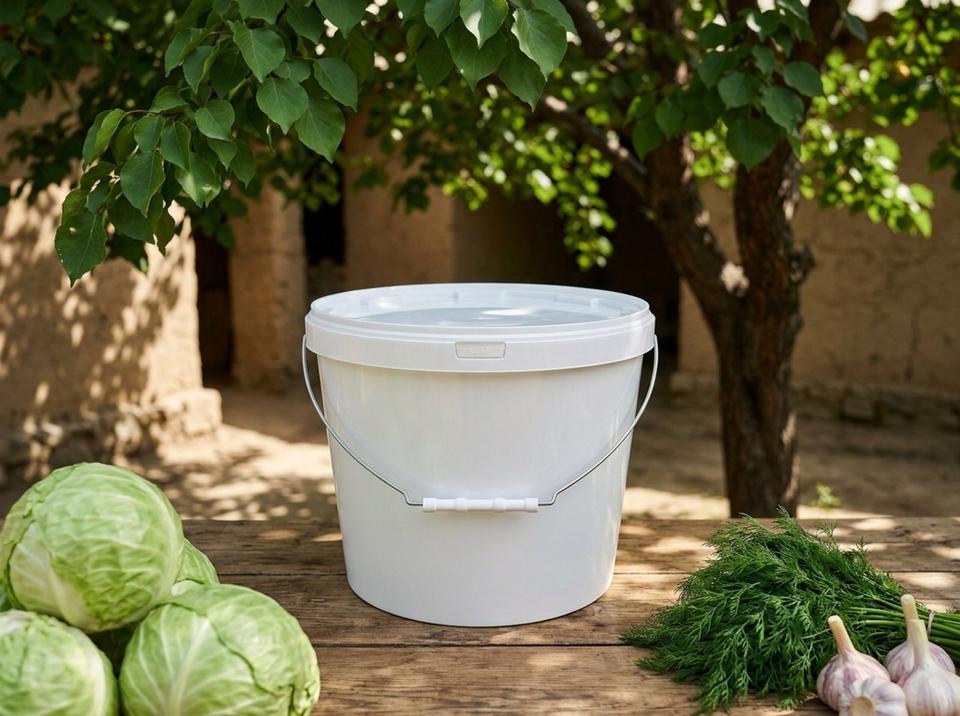
Tomatoes, peppers, cucumbers, and cabbage ripen almost all at once, so pickling happens in batches. The bucket opens to its full diameter, so vegetables are easy to layer, and after the sale the tapered bucket washes out easily for the next batch.
Jam from your own orchard
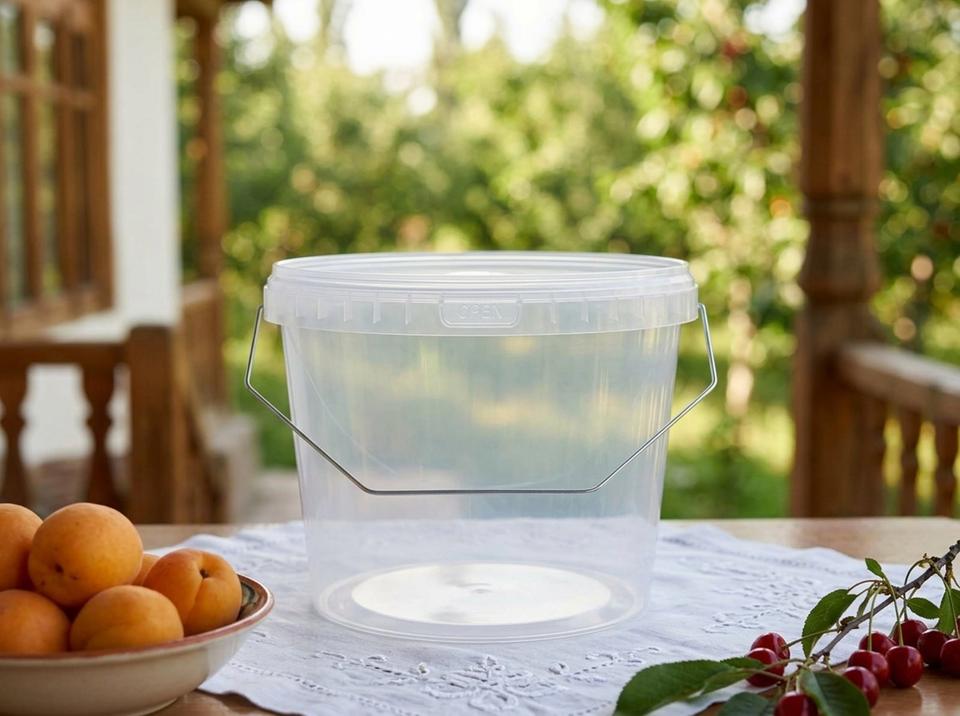
Apricots, cherries, and apples from southern orchards go into jam and fruit butter. A liter of jam weighs about 1.33 kg, so a 2.3 L bucket holds just over three kilograms, a handy size for a family. In a clear bucket, the color of the jam shows without opening the lid.
Honey, two ways
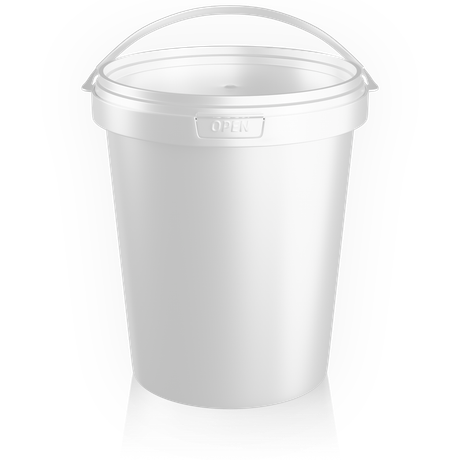
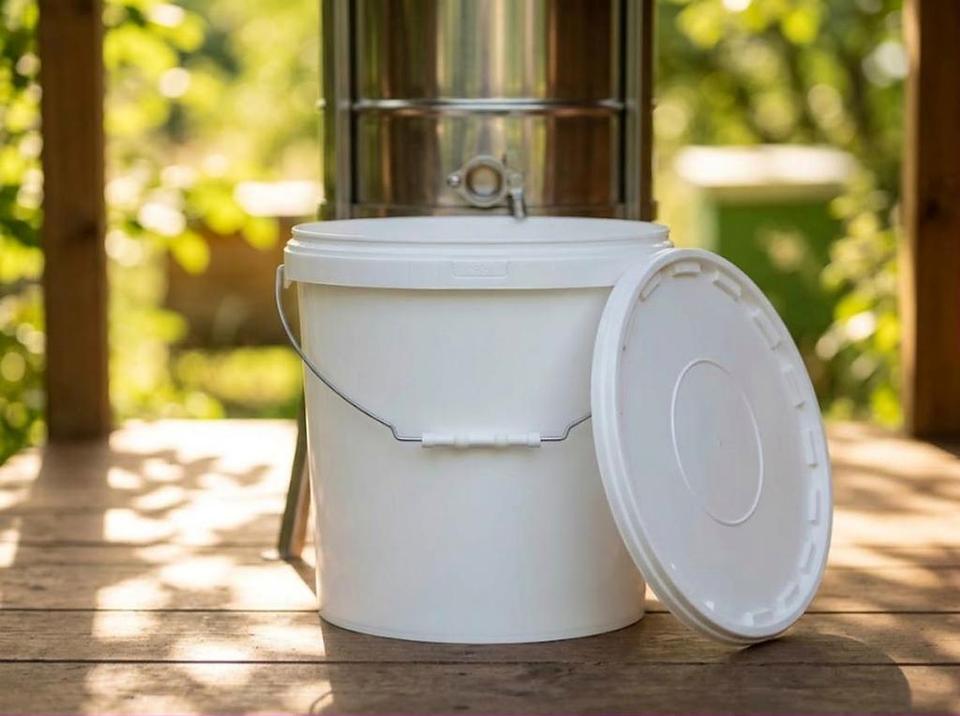
Honey from local apiaries sells in one-liter buckets at the bazaar and in bulk packaging to middlemen. For bulk, the 15 L and 21 L buckets work best: their metal bail handle has a plastic grip that won't cut into your palm, even with nearly 30 kg inside.
How to calculate
How many bucketsto order for the harvest
To avoid running short of packaging at the height of the season, or overstocking, work out your order in a few steps. All you need is your expected harvest in kilograms and the product weight for your chosen bucket from the cards above.
Divide your harvest by the weight of one bucket: 300 kg of pickles is about 125 buckets of 2.3 L.
Add a few extra for gifts to relatives and in case the harvest beats expectations.
Check the total against units per pallet: 3,300 buckets of 2.3 L, 1,920 of 5.6 L, or 816 of 11.5 L.
If it comes to less than a pallet, team up with neighbors or order several sizes at once; your sales manager will work out a mixed order.
Count rice and dry goods by gifts, not by weight: one 3.8 L bucket is one gift.
Shipment estimate
How much packagingfits in one delivery
Choose an item and quantity, and we'll show the pallet count, units rounded up to full pallets, total nominal capacity in liters, empty packaging weight, and the truck you'll need.
Straight-line distance. Click a city to open its page.
Buckets and jerry cans for Uzgen are made and palletized at our plant in the Bishkek Free Economic Zone (FEZ), Ak-Chiy village; we have no other warehouse. A freight carrier takes them south, and your sales manager will tell you which carrier, the transit time, and the shipping cost when you place your order. Farms that truck their own harvest to the capital for sale pick up pallets from the factory on the way back. Pickling and jam making start in summer and rice is harvested in the fall, so it makes sense to order packaging for the whole season in one go in spring: empty buckets nest in stacks and wait in the shed until harvest, taking up almost no room.
Yes. The buckets are molded from food-grade polypropylene, and the lid snaps into a double rim and seals the grain in tight. For gifts, people choose 2.3 to 3.8 L; for a family's supply, 5.6 or 8 L.
Usually 2.3 or 5.6 L, which hold about 2.4 and 5.9 kg including the brine. In a clear bucket, shoppers can see the tomatoes and peppers without taking off the lid. Learn more on our pickle buckets page.
About 3.1 kg, since a liter of jam weighs roughly 1.33 kg. Brim-full capacity is 2.444 L, and that extra headspace lets the lid sit evenly in the rim.
Pricing depends on size, quantity, color, handle, and printing, so your sales manager quotes each order individually. Call +996 222 600 292 and tell us what you plan to pack and how much.
By freight carrier from our plant in the Bishkek FEZ: we hand the pallets over to the carrier, and it delivers them to Uzgen. Your sales manager confirms delivery time and cost when you order. You can also pick up the buckets from the factory in your own vehicle.
Yes. Small orders get a stick-on label; large orders get IML printing, where the image is fused into the wall during molding and won't come off when you wash the bucket after pickles. It's a smart choice if you sell rice or honey under your own name.
You tear it off when you open the bucket for the first time. A shopper at the bazaar sees the seal intact and knows nobody has sampled the jam or honey since it was packed.
Catalog
Buckets and jerry cansfor Uzgen farms
Every size, with dimensions, weights, and handles, is in our catalog. For the full packaging lineup for a farm, see our page for farms and agribusinesses, and for neighboring Osh, see packaging in Osh.
Tell us your products and expected harvest in kilograms. Your sales manager will split it across sizes, count the buckets and pallets, and show you how to fit everything into one shipment to Uzgen.